
Your kilometres, turned into a defensible tax record.
ShiftClaim records your drives — rideshare, delivery or courier — classifies business vs personal automatically, and produces the ATO 12-week logbook, GST & BAS figures and EV charging records your accountant asks for. Everything stays on your device.
In App Store review · iPhone · A$0 to record, forever
Ten seconds, end to end.
A driver pulls up, a passenger gets in, and the trip is already on the record.

Rendered live in your browser — no video file to download.
Every figure your accountant asks for, already built.
Four screens replace the parts of tax time that usually go wrong — the logbook, the trip classification, the expenses and the BAS pack.
The logbook is live, week by week.
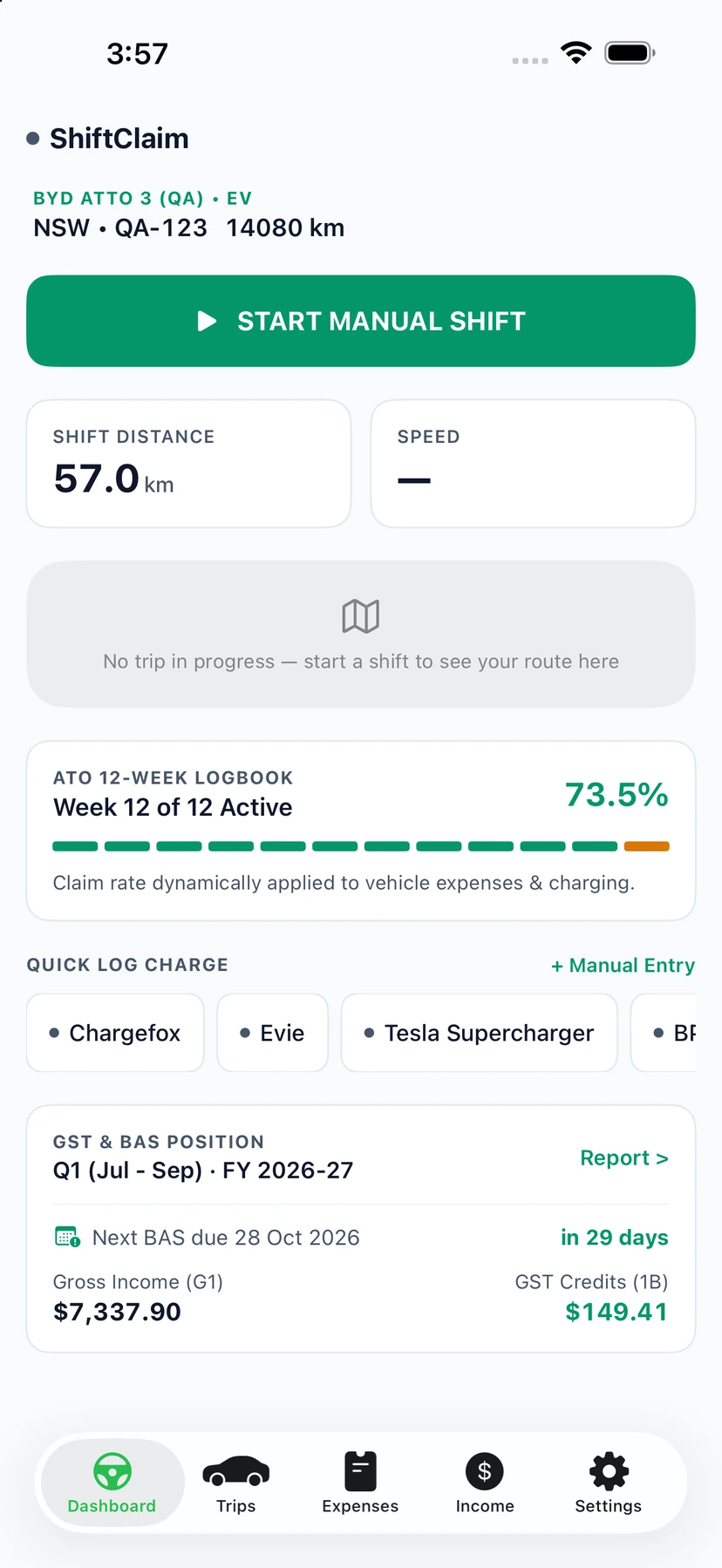
A continuous gauge tracks your 12-week period as you drive and computes your business-use percentage to four decimal places. Once the 12 weeks complete it stays valid for five years — which is exactly what an ATO review asks for.
- 84-day day-count arithmetic, day 1 counted
- Gauge matches the LogbookCalculator exactly
- Odometer continuity enforced at every shift boundary
Trips classify themselves.
Trips between pickups are business. Home commutes stay private — including the run home at the end of a shift, unless a passenger was in the car. A receipt-printed GST is apportioned correctly by your logbook, so the engine enforces the ATO rules rather than trusting you to remember them.
- Motion, shift-hours and saved-place auto-detection
- Tunnel GPS gaps flagged, never silently closed
- Every classification editable, with the reason shown

Charging is taxed the way the ATO expects.
Public charging claims GST ÷ 11 straight from the invoice. Home charging follows the ATO's Practical Compliance Guideline 2024/2 cents-per-km rate of 4.2¢, GST-excluded — with home-versus-public analytics per network, so you can see which is actually cheaper to run.
- Public and home charging captured separately
- Vehicle purchase GST capped at the car limit
- Toll detection across NSW, VIC and QLD

Your BAS pack exports itself.
A running quarterly position — G1, 1A, 1B and net GST — with a downloadable XLSX report. Import a payout PDF and ShiftClaim parses the lines for you; review them, then book. The tax-estimate card projects your full-year position as earnings come in.
- CSV, XLSX and PDF exports
- Payout PDF import with per-line review
- BAS deadline countdown on the dashboard

Built for the parts that go wrong.
The rules the engine enforces, so you're not reconstructing them at 11pm in July.
Manual & auto shift tracking
Start a manual shift with one tap — full GPS accuracy, never an automatic stop you didn't ask for — or opt in to battery-light auto-detection via motion, your shift hours or your saved places.
Automatic classification
Business between pickups, private for home commutes. Receipt-printed GST is apportioned by your logbook fraction, which is where most trackers quietly over-claim.
GST & BAS, live
A running quarterly position — G1, 1A, 1B and net GST — with a downloadable report, purchase credits capped at the car limit, and odometer continuity at every boundary.
Private by architecture
No accounts, no analytics, no advertising, no third-party SDKs. Records live in your device's storage and optionally your own iCloud. Receipts are read on-device.
Built for Australia, not adapted to it.
The four things that decide whether your BAS and logbook survive an ATO review — and what the alternatives actually do.
| Capability | ShiftClaim | International mileage tracker |
Manual log + spreadsheet |
|---|---|---|---|
| Live GST & BAS figuresG1, 1A, 1B and net GST computed from ATO rules as you drive | YesDiv 144 rules, logbook-apportioned GST and car-limit caps enforced by the engine | NoBuilt for the IRS, not the ATO | NoRe-derived by hand every quarter |
| ATO 12-week logbookWeek-by-week gauge, business-use % valid for five years | Yes84-day day-count arithmetic; the gauge matches the calculator exactly | NoGeneric trip logs, no ATO validity tracking | NoManual counting — where the classic under-count lives |
| EV charging tax enginePublic ÷11 GST, home charging per PCG 2024/2 | YesHome-vs-public capture per network, apportioned at the logbook rate | NoNo EV charging category anywhere | NoThe guideline is 40 pages of fine print |
| Private by architectureOn-device storage, no accounts, no analytics, no servers | YesRecords stay on your device and your iCloud; receipts read on-device | NoCloud accounts and analytics SDKs are the norm | NoPhotos and spreadsheets scattered across your phone |
Scroll the table sideways to compare →
Skip the BAS prep fee — lodge it yourself in minutes.
ShiftClaim computes the whole quarter for you: G1 sales, 1A credits, 1B GST on your fares, and the net position — every figure the BAS asks for, already apportioned by your 12-week logbook. Copy the numbers into the ATO Business Portal (free with myGovID) and the quarter is lodged before the coffee's cold.
If your accountant charges even $100 a quarter to prepare a BAS, self-lodging with ShiftClaim pays for Pro several times over — hundreds of dollars a year stays in your pocket. Prefer a second pair of eyes? Export the quarter as PDF or CSV and your accountant reviews instead of rebuilds.
Example figures from the app · not tax advice.

Your logbook never leaves your phone.
No account to create, no server to trust, no analytics to opt out of. ShiftClaim runs entirely on-device — the only optional cloud is your own iCloud, under your own key.
Record free. Pay when you need exports.
Trip recording is unlimited and free on every plan — that's the whole product. What costs money is unlimited exports. Every plan tracks one vehicle.
| Plan | Price (incl. GST) | Trip recording | Vehicles | GST/BAS exports |
|---|---|---|---|---|
| Free | A$0 | Unlimited | 1 | 2 BAS + 1 logbook |
| Pro Monthly | A$6.99 / month | Unlimited | 1 | Unlimited |
| Pro Annual | A$69.99 / year | Unlimited | 1 | Unlimited |
Scroll the table sideways →
The things people ask before they trust an app with their BAS.
Is the logbook ATO-compliant?
ShiftClaim keeps a continuous 12-week (84-day) logbook in the format the ATO expects for work-related car claims, updating the odometer and business-use percentage as you drive. It is record-keeping software, not tax advice — your accountant still lodges the return.
Do I need an ABN or GST registration to use it?
You can record trips and keep a logbook without either. Claiming GST credits on your running costs does require an Australian business number and GST registration.
What is free, and what costs money?
Trip recording is unlimited and free on every plan, for one vehicle. The free tier includes two BAS exports and one logbook export. Pro is A$6.99 a month or A$69.99 a year, and makes exports unlimited.
Where does my data actually go?
It stays on your iPhone. There is no account to create and no ShiftClaim server holding your records — the only cloud involved is your own iCloud, under your own key, if you choose to back up.
Does it work for rideshare, delivery and courier work?
Yes. Trips are classified business or personal automatically and you can override any of them. Income and GST are tracked per trip, so the BAS figures are already reconciled when you export.
Can I claim EV charging?
EV charging is recorded per session and treated under PCG 2024/2, so the kWh and cost tie back to that guidance rather than an estimate from your power bill.
Stop reconstructing your quarter.
ShiftClaim keeps the logbook, the GST and the odometer honest while you drive.
Notify me at launch See the app first